
TL;DR
- North American data center vacancy was 1% at year-end 2025, the second consecutive year at that level, and 92% of capacity under construction was already precommitted (JLL, 2026). The site and the equipment are separate assets with different markets and different value drivers.
- Many existing data centers were designed for 5 to 15 kW per rack and are insufficient for the 40-kW-plus densities AI workloads require (CBRE, 2026). A twenty-year-old buildout can be an obstacle rather than an asset.
- 82% of operators report having no racks above 30 kW (Uptime Institute, 2025), suggesting that inherited infrastructure rarely meets high-density demand.
- Large power transformer lead times are commonly quoted at 36 months, with some reaching 60 months (DOE, 2024). Grid-connected power capacity is worth protecting.
- Recoverable equipment carries data center asset recovery value that can offset removal costs. For its AES Blue Cross project, Quantum Technology purchased the generators, switchgear, UPS systems, and AC systems and applied the revenue to the client’s decommissioning cost.
The Strategic Value of Vacant Data Center Repositioning
Data center decommissioning is the process of safely disconnecting, removing, and disposing of the electrical and mechanical equipment inside a facility so the building itself can be repurposed, redeveloped, or re-leased. For owners of an idle facility, that distinction matters more than it first appears.
The land, power access, fiber, zoning, and reinforced construction that make a former data center hard to replicate are separate assets from the aging generators, UPS systems, and chillers installed inside. In a market where North American vacancy sat at 1% at year-end 2025 (JLL, 2026), preserving the site and preserving the equipment are two different decisions, and treating them as one can cost you money.
This is a guide to vacant data center repositioning that helps owners separate what is genuinely scarce from what is simply old. It is also a guide to getting value from what you remove: recoverable generators, UPS systems, chillers, switchgear, and cabling can be reconditioned and resold in a live secondary market rather than sent to a landfill, and that recovery revenue can offset a meaningful share of the removal cost.
Why Is the Site Scarce Even When the Equipment Isn’t?
The site is scarce because power availability and infrastructure delivery timelines have become the constraint, not the shortage of buildings. Power availability and infrastructure delivery timelines were the most decisive factors shaping site selection, leasing activity, and pricing across major U.S. markets in the first half of 2025 (CBRE, 2025a). When power is the bottleneck, a facility that already has utility power, an approved use history, fiber, and equipment yards has attributes that a new developer cannot quickly replicate.
The numbers back this up:
- Under-Construction Capacity: More than 35 GW of capacity was under construction across North America at year-end 2025, with 92% already committed through binding leases or owner-occupied development (JLL, 2026).
- Preleasing Activity: Preleasing reached 74.3% of under-construction capacity across major markets (CBRE, 2025a).
- Northern Virginia Vacancy: In the largest U.S. market, vacancy sat at 0.5% in 2025 and dropped to an unprecedented 0.3% in Q1 2026 (CBRE, 2025b; CBRE, 2026).
Here’s the part worth sitting with: none of that scarcity is about installed generators, UPS modules, or chillers. It’s about location, power, connectivity, and permitting. Those are real estate and utility attributes. The equipment inside is a separate question with a separate answer.
Why Do Old Buildouts Mismatch New Demand?
Old buildouts no longer meet new demand because rack densities and cooling strategies have evolved faster than most existing infrastructure can keep up. Many existing data centers were designed for 5 to 15 kW per rack and are insufficient for the 40-kW-plus densities AI workloads require (CBRE, 2026). For operators with substantially different density or cooling requirements, portions of an older buildout may need to be replaced or redesigned.
The operator data reinforces the gap (Uptime Institute, 2025):
- Average Rack Densities: The most common modal average rack density is 4 to 5 kW (reported by 30% of operators), with only 4% operating at 20 to 29 kW and 2% exceeding 50 kW.
- High-Density Capacity: At the high end, 82% of operators report having no racks above 30 kW, 17% operate some racks in the 30-49 kW range, and 9% report racks at 50 kW or more, while cabinets exceeding 100 kW remain rare.
When an incoming tenant needs to build for high density, an inherited low-density MEP layout may have limited value to a high-density operator and should be evaluated against the requirements of the likely next user.
Cooling has shifted too:
- The Shift to Liquid: Liquid cooling is becoming essential for high-density racks. A hybrid approach is typically 70% liquid and 30% air, and in new construction, liquid-cooling infrastructure has quickly become the default installation (JLL, 2025).
- Thresholds for Adoption: Most operators believe direct liquid cooling becomes necessary in the 20-39 kW range, with 29% citing 20-29 kW (Uptime Institute, 2024).
- The Weight of Immersion: There is a structural wrinkle, too. The largest immersion cooling baths can weigh up to 4 metric tons, and immersion is used in fewer than 10% of data centers today (JLL, 2025).
A cooling plant designed for low-density air is not what a liquid-first operator wants to inherit.
Powered Shell vs. Turnkey: What Actually Transfers to a Buyer?
A powered shell data center is a facility delivered with the physical structure, site power, and connectivity infrastructure in place, while the interior fit-out is left to the tenant. It is a useful framework for owners because it separates durable, hard-to-replicate assets from disposable ones. Core-and-shell and turnkey are distinct delivery models (Baker McKenzie, 2025), representing the fork in the road owners face when a facility goes idle. In practical terms, this fork is where the decision to reposition vacant data centers is made: everything upstream is analysis, and everything downstream is execution.
This matters because modern operators typically want to design their own infrastructure around specific redundancy tiers, manufacturers, emissions standards, power densities, and cooling strategies. For example, the Tier standard (Uptime Institute, n.d.) defines specific operational baselines:
- Tier III: Concurrently maintainable with redundant components and distribution paths.
- Tier IV: Adds fault tolerance through independent, physically isolated systems.
Achieving these specific outcomes requires strict control of Tier-relevant components, including engine generators, energy storage, chillers, cooling units, UPS modules, pumps, heat-rejection equipment, and fuel tanks. A tenant chasing a specific Tier outcome will often reject inherited MEP rather than validate someone else’s twenty-year-old choices against their design.
Comparison: Powered Shell vs. Turnkey Data Center Models
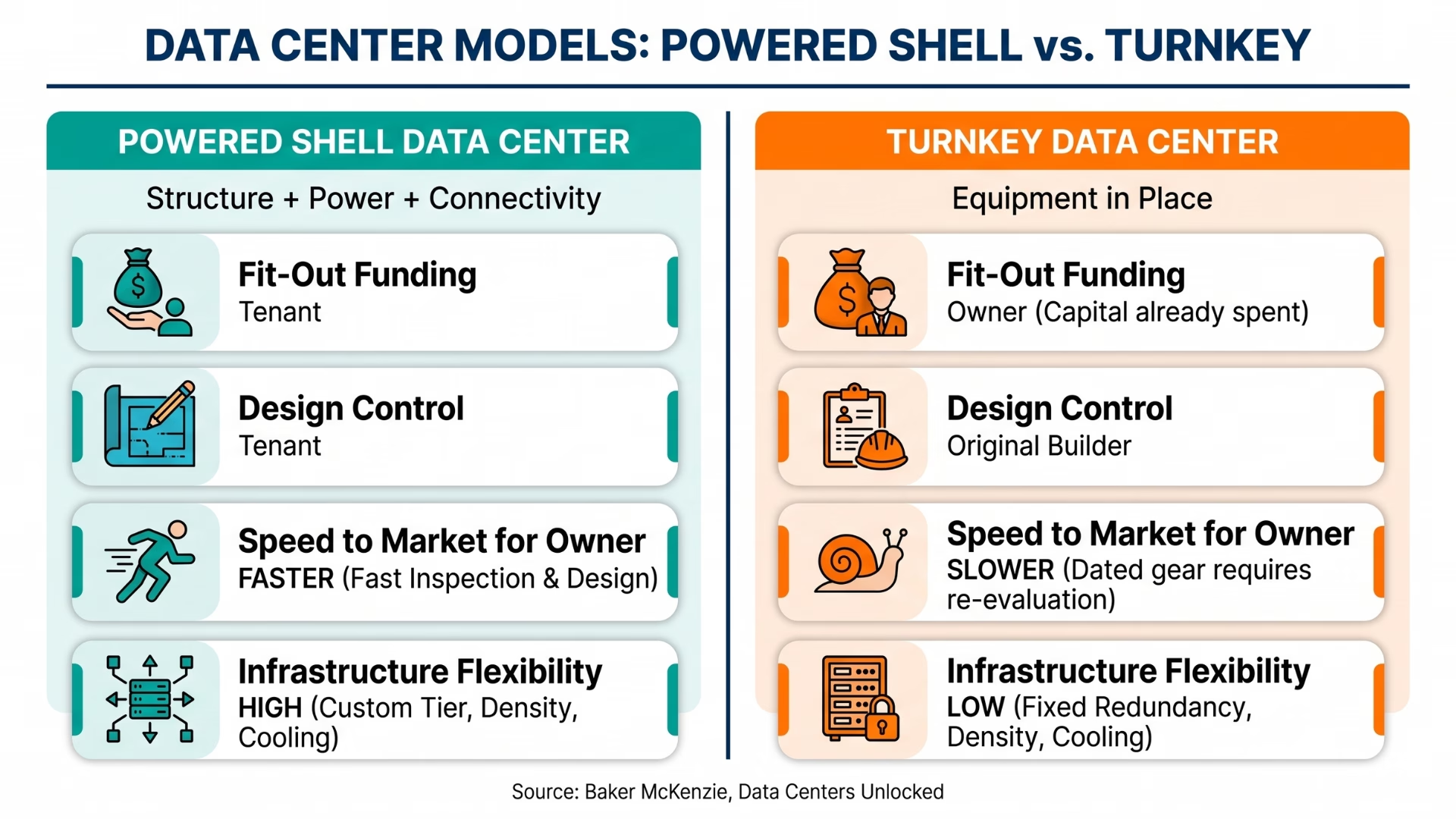
| Data Center Delivery Model | Fit-Out Funding | Design Control | Speed to Market for Owner | Tenant Infrastructure Flexibility |
|---|---|---|---|---|
| Turnkey Data Center (Equipment in Place) | Owner (capital already spent) | Original Builder | Slower (if dated gear requires re-evaluation) | Low (Tenant inherits fixed redundancy, density, and cooling) |
| Powered Shell Data Center (Structure + Power + Connectivity) | Tenant | Tenant | Faster (Clean space is easy to inspect and design around) | High (Tenant builds to custom Tier, density, and cooling) |
Source for the model definitions: Baker McKenzie, Data Centers Unlocked.
Does Upgrading Aging Infrastructure Actually Attract a Buyer?
Whether to upgrade or sell as-is depends on whether current operators actually want the installed gear, and the density data suggests many won’t. If an incoming operator is building for high-density or AI workloads that require the 40-kW-plus-per-rack density, spending money to modernize a legacy buildout can be throwing good money after bad. The buyer will still redesign around their own tier, manufacturers, and cooling approach.
For some owners, a cleaner path may be to deliver a powered shell data center. That preserves the scarce assets, the structure, utility power, and connectivity, while removing the outdated interior a buyer would strip anyway. A clean shell is also easier to inspect, design, finance, and redevelop, which can widen the pool of prospective buyers rather than narrowing it to the few who happen to want a specific inherited infrastructure.
Is It More Profitable to Sell the Data Center Turnkey or Sell the Real Estate and Hardware Separately?
It can be more profitable to separate the two because the real estate, power capacity, and equipment are distinct markets with distinct buyers. The building’s scarcity is tied to power and location, both of which are in high demand. The hardware, by contrast, has its own resale channel.
Recoverable generators, UPS systems, chillers, cooling equipment, racks, and cabling carry data center asset recovery value. Our used-equipment marketplace lists a Used Generators collection with 174 products and prices used switchgear directly, such as a Square D QED-2 switchboard listing. Pricing and inventory change over time, so any figure should be treated as a snapshot. The point stands: when a live resale market exists for the hardware, selling turnkey to a buyer who plans to remove it anyway may leave that recovery value on the table.
Should I Sell My Data Center, Lease It, or Dismantle It to Reuse the Space?
The right choice depends on the balance between the demand for your site’s power and location and the demand of the equipment installed there. With North American vacancy at 1% and 92% of construction precommitted (JLL, 2025), the site and its grid-connected power capacity are usually the durable value, which argues for keeping the property rather than walking away.
The equipment is the part worth reassessing. Where the installed equipment does not match likely tenant requirements, dismantling to a clean powered shell can preserve the underlying value of the site while recovering value from the equipment, leaving a space that is easier to inspect, finance, and redevelop. Leasing as-is tends to make sense only when a tenant genuinely wants the existing infrastructure.
What Does Data Center Equipment Removal Actually Involve?
Data center equipment removal involves safely disconnecting and dismantling the facility’s electrical and mechanical systems, then routing each item for reuse, resale, or recycling.
Quantum Technology’s data center decommissioning scope covers the safe disconnection and removal of critical infrastructure, including:
- Power Systems: Gas and diesel generators (with fuel tanks and support equipment), UPS systems (with batteries), switchgear, and electrical distribution.
- Mechanical & Cooling: Cooling towers, chillers, pumps, and HVAC infrastructure.
- Facility Cabling & Racks: Server racks, overhead cable trays, and copper/fiber cabling.
The routing decision is where environmental sustainability and financial recovery meet:
- Secondary Market Resale: Equipment with remaining service life is reconditioned and resold, capturing data center asset recovery value to offset labor costs.
- Material Recycling: Materials that cannot be reused are processed through certified recycling channels.
- Responsible Disposal: Only non-recoverable, non-recyclable remnants are routed to final disposal.
Every generator or switchgear lineup returned to service avoids the environmental cost of manufacturing new equipment while preserving capital for the site owner.
It isn’t only logistics; dismantling a site involves critical compliance and safety touchpoints. This requires safely de-energizing systems using proper safe-off and lockout/tagout procedures (OSHA, n.d.). It also means managing UPS batteries under universal waste rules and adhering to local and federal environmental requirements regarding fuel handling, refrigerants, and stationary backup generators. These regulations vary by jurisdiction, requiring a knowledgeable partner to ensure the project stays compliant.
An 8-Step Vacant Data Center Repositioning Diagnostic
Use this checklist to decide what stays, what goes, and how a powered shell data center might serve an owner better than a turnkey sale. It sequences the data center equipment removal decision from market analysis through final disposition.
- What is the true market demand for the site? Assess how scarce your specific location and grid-connected power truly are.
- Does the facility match modern density needs? Compare your current per-rack design to the requirements of high-density AI workloads.
- What equipment would a new operator actually keep? Evaluate whether your existing infrastructure aligns with a buyer’s expected redundancy Tiers.
- What are the cooling requirements? Determine whether an incoming tenant will require direct liquid cooling rather than your existing air-cooled plant.
- What can be recovered and resold? Identify which generators, UPS systems, and chillers have secondary market value.
- What does removal actually cost? Outline the logistics, safety protocols, and compliance requirements for a safe disconnect.
- What is the net recovery value? Calculate how much of the decommissioning labor can be offset by selling the recovered equipment.
- What must remain with the building? Clearly separate the disposable interior assets from the durable real estate, power, and fiber that define a powered shell.
Why Does Time Work Against Idle Equipment?
Time works against idle equipment because its resale value can erode while the building sits vacant, even as the underlying power capacity retains its value. Grid-connected power is a durable asset in a constrained market. Large power transformer lead times are commonly quoted at 36 months and can reach 60 months, making the limited availability of spare large power transformers a resilience concern (DOE, 2024). That is a reason to protect a site’s power capacity, not to leave equipment aging in place, hoping it appreciates.
Older gear can still sell, which is a reason to act sooner rather than later. On the Bank One project, Quantum Technology sold four Cummins generators dating from 1979, along with the switchgear, generators, and chillers it dismantled on site. Idle equipment continues to age, and its resale value can decline as models become obsolete or buyer demand changes. A live resale channel and a clear removal plan usually beat indefinite storage.
Case Studies in Asset Recovery
Quantum Technology has run this play on its own projects. Both of the following examples show the same pattern: separating equipment value from real estate value can offset the cost of clearing a facility for its next use, whether that use is a powered shell listing or a completely redeveloped site.
- AES Blue Cross: Quantum Technology purchased the generators, switchgear, UPS systems, and AC systems outright, applying that equipment revenue directly toward the client’s decommissioning costs.
- Bank One: Quantum Technology dismantled and removed the switchgear, generators, and chillers, and safely disconnected the UPS systems and transformers to clear the facility.
Because Quantum Technology both removes the equipment and resells it through its own equipment division, the data center asset recovery value remains within a single engagement rather than being split between a demolition contractor and a broker. You can explore more examples of this recovery process in our full library of data center decommissioning case studies.
Working With Quantum Technology
Quantum Technology decommissions and dismantles data centers and purchases the equipment removed from them. But our true differentiator is that we understand both sides of the equation: we know what infrastructure has value left in place, and what has greater value when removed, reconditioned, and resold. Because our team handles both the safe removal and the resale channel, the recovered value is credited directly against your project cost.
If you are holding a vacant facility and trying to decide what to keep, the best place to start is a walkthrough and an equipment inventory. See our data center decommissioning services, or browse our used equipment marketplace to see what assets like yours are selling for today.
FAQ
1. What is vacant data center repositioning?
Vacant data center repositioning is the process of deciding what an idle facility should become next and which of its assets should carry forward into that use. It treats the site, meaning land, utility power, fiber, zoning, and structure, as separate from the installed electrical and mechanical equipment, then makes a distinct call on each. Repositioning separates these elements because a site’s value is heavily driven by power and location, while the installed equipment may or may not align with an incoming tenant’s specific density requirements. Repositioning is the work of correctly evaluating and pricing that difference.
2. Should I upgrade aging infrastructure to attract a buyer, or sell the data center as-is?
It depends on whether the buyers you’re targeting actually want the installed gear. An operator building for high-density AI workloads will often redesign around their own Tier, manufacturers, and cooling approach. Instead of upgrading, some owners find it more effective to deliver a clean, powered shell that preserves the structure, utility power, and connectivity. This can make the space easier to inspect, design, finance, and redevelop, widening the buyer pool.
3. Should I sell my data center, lease it, or dismantle it to reuse the space?
The right choice depends on the demand for your site’s power and location versus the demand for its installed equipment. In a constrained market, the underlying site and grid-connected power capacity are often the most durable values. If your installed equipment does not align with a new tenant’s density needs, dismantling it to a clean, powered shell can make the space easier to inspect and lease, while allowing you to recover the hardware’s resale value.
4. Can a decommissioning company use the resale value of our equipment to offset labor costs?
Yes. This is how Quantum Technology structures many of its engagements. On the AES Blue Cross project, Quantum Technology purchased the generators, switchgear, UPS systems, and AC systems, and applied the equipment revenue toward the client’s decommissioning cost. Actual offsets depend on the specific equipment, condition, and current market, since resale prices and inventory change, so any offset should be treated as project-specific rather than guaranteed.
5. What’s the biggest mistake companies make when shutting down a data center?
A common mistake is conflating the value of the site with the value of the installed equipment. The site’s scarcity comes from power availability, connectivity, zoning, and location. The equipment is a separate asset with its own market dynamics. Assuming that an older buildout will perfectly match a new tenant’s needs can sometimes shrink the buyer pool or invite buyers to arbitrarily price removal into their offer.
6. Does removing the equipment hurt the property’s value as a data center?
Not necessarily, because the attributes that make a data center site hard to replicate are usually its real estate and utility connections. Grid-connected capacity is a highly durable asset. Removing equipment clears the interior; it does not remove the utility power, fiber, zoning, or approved use history that a new developer cannot assemble quickly.
7. What does a powered shell mean compared with turnkey?
A powered shell data center provides the structure, site power, and connectivity infrastructure, leaving the interior fit-out to the tenant. Turnkey and core-and-shell are distinct delivery models, per Baker McKenzie’s Data Centers Unlocked report. The practical difference is control: a powered shell lets the tenant design around its own redundancy tier, manufacturers, density, and cooling, which is often exactly what modern operators prefer.
8. At what density does liquid cooling become necessary?
Most operators set the threshold between 20 and 39 kW per rack. The Uptime Cooling Systems Survey 2024 found that 29% of operators think direct liquid cooling becomes necessary at 20 to 29 kW and 19% at 30 to 39 kW, with cost, reliability, and maintenance cited as top adoption barriers. JLL’s Global Data Center Outlook 2025 notes that liquid cooling is now the default in new construction, which is why some high-density operators may opt to replace an older air-cooled plant with their own modern liquid-cooling infrastructure.
Works Cited
- Baker McKenzie. Data Centers Unlocked. Baker McKenzie, 2025, www.bakermckenzie.com/-/media/files/insight/publications/2025/12/baker-mckenzie-data-centers-unlocked.pdf.
- CBRE. Global Data Center Trends 2026. CBRE, 2026, www.cbre.com/insights/reports/global-data-center-trends-2026.
- CBRE. North America Data Center Trends H1 2025. CBRE, 2025a, https://www.cbre.com/insights/reports/north-america-data-center-trends-h1-2025.
- CBRE. Northern Virginia Extends Lead as Largest U.S. Data Center Market in 2025. CBRE, 2025b, https://www.cbre.com/press-releases/northern-virginia-extends-lead-as-largest-u-s-data-center-market-in-2025.
- DOE. Large Power Transformer Resilience Report to Congress. U.S. Department of Energy, 2024, www.energy.gov/sites/default/files/2024-10/EXEC-2022-001242%20-%20Large%20Power%20Transformer%20Resilience%20Report%20signed%20by%20Secretary%20Granholm%20on%207-10-24.pdf.
- EPA. Compliance Requirements for Stationary Engines. U.S. Environmental Protection Agency, 2026a, www.epa.gov/stationary-engines/compliance-requirements-stationary-engines.
- EPA. Understanding Stationary Engines Rules. U.S. Environmental Protection Agency, 2026b, www.epa.gov/stationary-engines/understanding-stationary-engines-rules.
- EPA. Frequent Questions About Universal Waste. U.S. Environmental Protection Agency, 2025a, www.epa.gov/hw/frequent-questions-about-universal-waste.
- EPA. Universal Waste. U.S. Environmental Protection Agency, 2025b, www.epa.gov/hw/universal-waste.
- JLL. North America Data Centers Market Dynamics. JLL, 2026, https://www.jll.com/en-ca/insights/market-dynamics/north-america-data-centers.
- JLL. Global Data Center Outlook 2025. JLL, 2025, https://www.jll.com/content/dam/legacy/jll-com/documents/pdf/research/global/jll-data-center-outlook-2025.pdf.
- OSHA. 29 CFR 1910.147, The Control of Hazardous Energy (Lockout/Tagout). Occupational Safety and Health Administration, n.d., www.osha.gov/laws-regs/regulations/standardnumber/1910/1910.147.
- Uptime Institute. Global Data Center Survey 2025 (Report 180). Uptime Institute, 2025, https://datacenter.uptimeinstitute.com/rs/711-RIA-145/images/2025.Annual.Survey.Report.pdf?version=0.
- Uptime Institute. Cooling Systems Survey 2024. Uptime Institute, 2024, https://intelligence.uptimeinstitute.com/sites/default/files/2024-05/Uptime%20Institute%20Cooling%20Systems%20Survey%202024_0.pdf.
- Uptime Institute. Tier Standard. Uptime Institute, n.d., https://uptimeinstitute.com/tiers.


