
Reuse vs. Recycling: Zero-Landfill Data Center Decommissioning
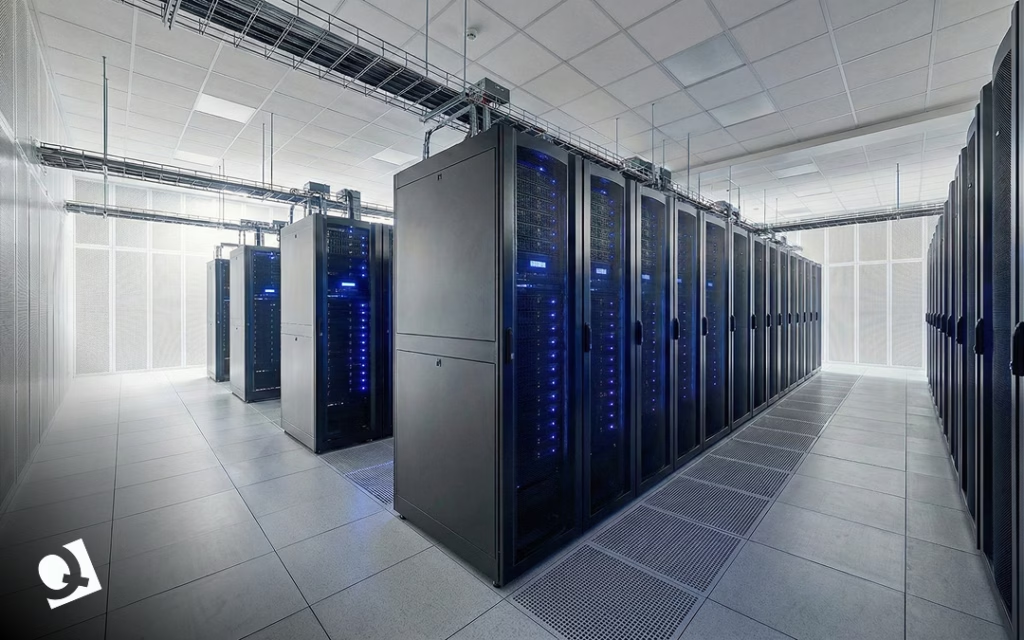
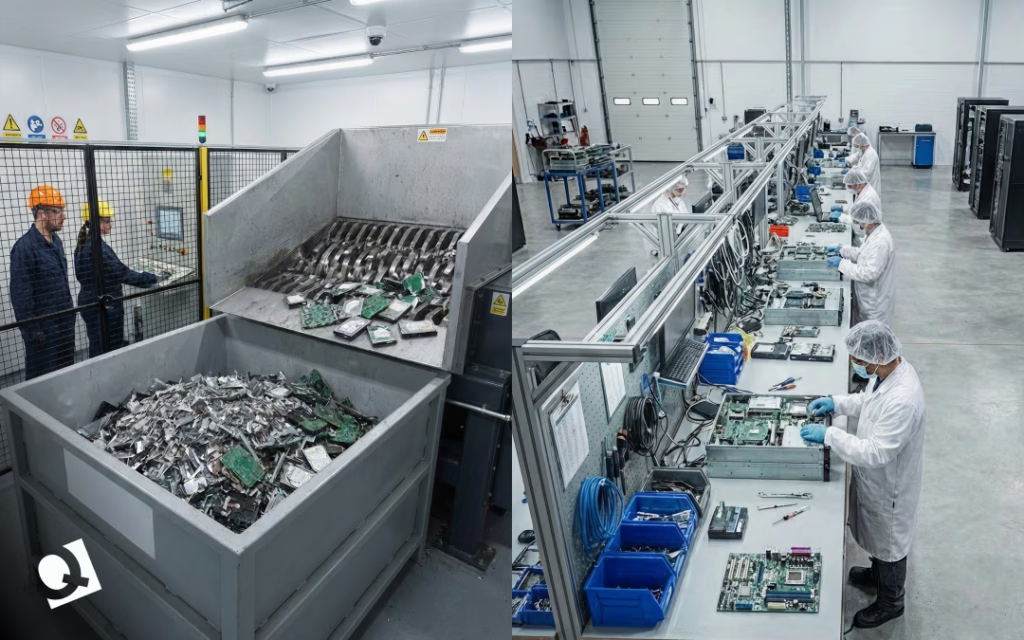
Zero-landfill data center decommissioning is a teardown method that prioritizes reuse first and responsible recycling second, ensuring the vast majority of removed assets are resold, repurposed, or properly recycled rather than dumped. At Quantum Technology, that means we disconnect, remove, rig, and demolish your physical infrastructure, then route each asset to its highest and best outcome under a documented, R2-certified decommissioning process.
TL;DR: The Fast Version
- The world generated 62 billion kg of e-waste in 2022, and only 22.3% was formally collected and recycled in an environmentally sound way (ITU, 2024a). That gap is exactly what a zero-landfill data center decommissioning process is built to close.
- The US EPA waste management hierarchy ranks reuse ahead of recycling, and recycling ahead of disposal, so a responsible data center disposal approach prioritizes resale first (EPA, 2025b).
- The U.S. lead battery recycling rate is 99%, which is why spent UPS strings almost always route to recycling rather than reuse (EPA, 2025a).
- R2 downstream controls exist to track material flow to final disposition, according to the Summary of R2v3 Requirements, so you can prove what actually happened after equipment left your building, which is the foundation of credible data center recycling.
What Does Zero Landfill Data Center Decommissioning Actually Mean?
Zero-landfill data center decommissioning means diverting infrastructure components from landfills. Instead, equipment follows a decision path: resell it if it holds market value, repurpose it if a second life exists, or recycle it responsibly with documented disposition when reuse is no longer feasible.
The honest part matters here. “Zero landfill” is only credible if you define the accounting boundary. Validation frameworks handle accounting boundaries differently:
- UL 2799 Designation Tiers:
- Silver: 90%–94% diversion rate (includes waste-to-energy)
- Gold: 95%–99% diversion rate
- Platinum: 100% diversion rate
- TRUE Zero Waste (GBCI): Requires a minimum of 90% diversion away from landfills, incineration, waste-to-energy, and the environment over a 12-month period (GBCI, n.d.; USGBC, 2025).
Accounting details matter: UL notes that waste-to-energy produces ash that generally ends up in landfills, which separates a legitimate diversion claim from a marketing line.
Why Does This Matter Right Now?
It matters because recycling is not keeping pace with equipment coming out of service, and because data centers themselves are generating more end-of-life events than ever before. The ITU and UNITAR Global E-waste Monitor 2024 documented 62 billion kg of e-waste in 2022, of which only 22.3% was formally collected and recycled in an environmentally sound manner (ITU, 2024a). The ITU news release summed it up plainly: the world is generating record e-waste and recycling far too little (ITU, 2024b). The WHO e-waste fact sheet confirms the same 2022 figure (WHO, 2023). On the positive side, the ITU also notes that formal recycling in 2022 avoided a meaningful amount of upstream emissions, much of it tied to recovered refrigerants and to avoided mining, which is a direct argument for routing equipment through controlled channels rather than informal ones.
At the same time, data center capacity is scaling quickly enough that decommissioning is becoming a recurring operational event rather than a rare one. The Department of Energy has documented U.S. data center electricity use climbing from 58 terawatt-hours in 2014 to 176 terawatt-hours in 2023, and the updated 2025 report projects consumption reaching between 521 and 843 terawatt-hours by 2030 (LBNL/DOE, 2025). That pace of growth means more retrofits, consolidations, and facility relocations, and each one produces a wave of infrastructure that needs a responsible exit path.
Reuse vs. Recycling: What Is the Difference, and Which Comes First?
Reuse extends an asset’s working life by returning it to service or reselling it; recycling recovers the raw materials when the asset itself can no longer be used. The EPA waste management hierarchy places reuse above recycling (EPA, 2025a), and the EPA pollution prevention page lays out the full order: source reduction, reuse, recycling, treatment, and disposal (EPA, 2026a). Applied to a data center, that order becomes a working rule. A functional UPS, switchgear lineup, or generator with resale value should be evaluated for reuse before anyone reaches for a recycling bin. When an asset is spent, contaminated, or rendered unsafe for return to service, recycling becomes the responsible endpoint. Disposal is the last resort we design out.
The catch is that “recycle it” only counts if you can prove where it went. That is where R2 downstream tracking comes in, and it is why data center recycling through a certified partner differs from handing pallets to a broker (Sustainable Electronics Recycling International, n.d.). A partner’s business model matters here too: a company with a genuine resale channel, including warehouse space to receive, refurbish, and ship recovered equipment, is structurally motivated to push assets up the hierarchy toward reuse rather than defaulting to recycling by weight.
Reuse vs. Recycling by Equipment Category
Cisco describes core data center components, including UPS, cooling systems, fire suppression, and backup generators. The Idaho National Laboratory Data Center Playbook maps the power path through switchgear, transformers, UPS systems, and PDUs down to the IT racks (INL, 2026), and Legrand references UPS, switchgear, and transformers as core critical-power elements (Legrand, 2025). Those categories are exactly what we plan for in a teardown.
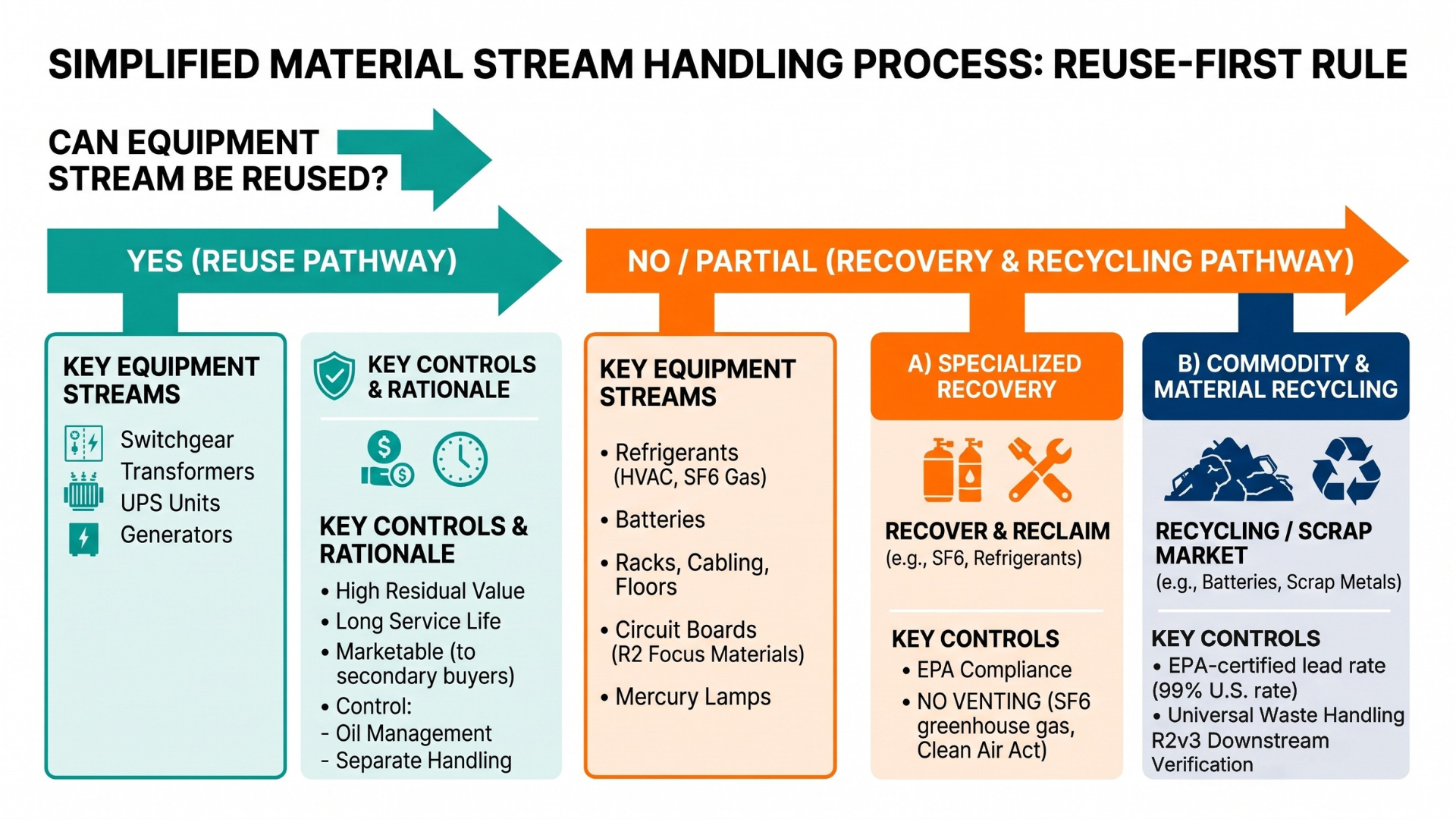
Here is how the reuse-first rule plays out across the streams we handle:
| Equipment category | Primary outcome | Why | Key control |
|---|---|---|---|
| Switchgear, transformers | Reuse/resale where feasible | High residual value, long service life, and long replacement lead times make refurbished gear valuable | Screen older transformers for PCB risk per EPA TSCA rules |
| UPS systems (units) | Reuse/resale where feasible | Marketable to secondary buyers | Batteries removed and routed separately |
| UPS battery strings | Recycling | Spent lead-acid batteries hit a 99% U.S. recycling rate, per the EPA lead-acid battery case study | Universal waste handling per 40 CFR part 273 |
| Chillers, CRAC, HVAC | Recover refrigerant, then reuse or recycle | Venting is prohibited under the Clean Air Act Section 608, and resale of used refrigerant is restricted unless reclaimed by an EPA-certified reclaimer | Certified refrigerant recovery per EPA Section 608 guidance |
| Generators | Reuse/resale where feasible; drain fluids | Strong secondary market | Used oil managed under 40 CFR part 279 |
| Racks, cabling, raised floor | Recycle commodities | Low reuse value; high material recovery; feeds a large existing scrap metal market | Weigh and document by stream |
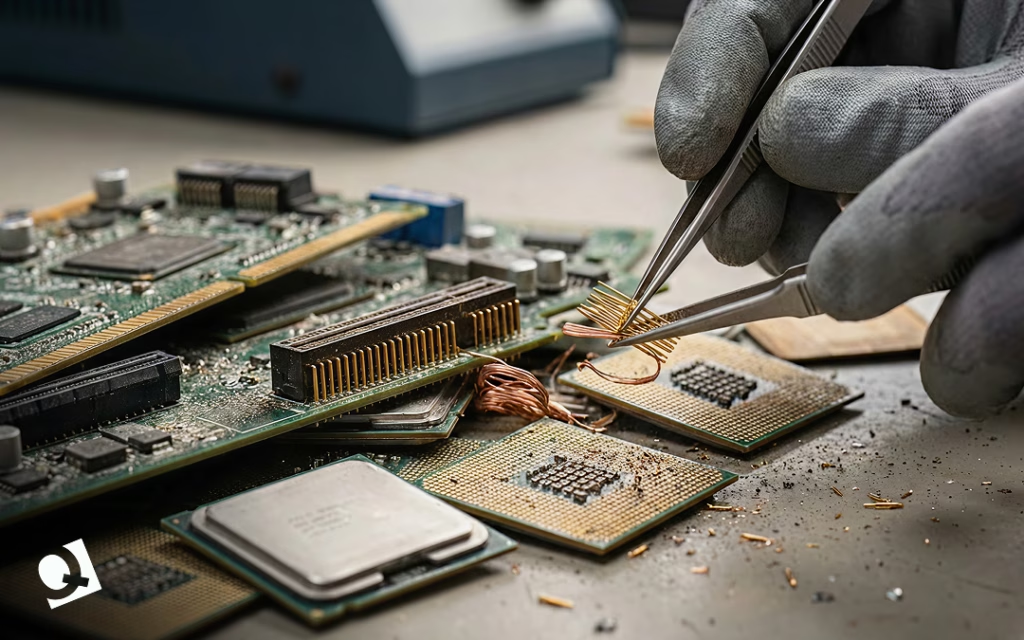
| Circuit boards, mercury lamps | Recycling under Focus Materials controls | Listed R2 Focus Materials | Downstream verification per R2v3 |
| High-voltage switchgear insulating gas (SF6) | Recover, do not vent | SF6 is a potent greenhouse gas used in circuit breakers and gas-insulated switchgear | Recovery per EPA SF6 emission-reduction guidance |
How Do I Make Sure Equipment Is Recycled Responsibly and Not Sent to the Landfill?
You make sure by choosing a partner whose recycling is governed all the way to final disposition, not just to the loading dock. According to SERI’s R2 overview, R2 covers the primary facility and its downstream vendors to ensure electronics are responsibly reused or recycled at every step (SERI, n.d.-b). The Summary of R2v3 Requirements states that Appendix A exists to ensure requirements are met throughout the downstream chain until final disposition, which includes verifying downstream vendors and tracking and documenting flows.
That is the difference between a real zero-landfill outcome and a hopeful one. A broker-only handoff loses the trail the moment pallets leave the site. A partner with downstream chain governance keeps verifying and documenting, so contamination or a bad downstream vendor cannot quietly turn “recyclable” into “landfilled.” SERI even maintains a directory of R2-certified facilities you can use to check any vendor’s claim (SERI, n.d.-c).
Why Is R2 Certification Important When Choosing a Data Center Recycler?
R2 certification is important because it evaluates and monitors a business against a published standard designed to protect the environment, worker health and safety, and communities, according to SERI’s FAQs. For a teardown, that means your data center e-waste recycling is judged against consistent rules rather than a vendor’s word.
R2 also governs hazardous streams through its Focus Materials list, which the R2v3 summary identifies as circuit boards, batteries, mercury, CRT glass, and PCBs. Those are the materials most likely to cause harm if mishandled, and they are common in aging infrastructure.
How Does Quantum Technology Handle Regulated Materials?
We handle them by identifying regulated streams up front and routing each through the appropriate compliance path. Getting this wrong is not a minor issue; it is a legal one.
- Refrigerants. The EPA states that Section 608 of the Clean Air Act prohibits the intentional venting of refrigerants when disposing of refrigeration and AC equipment and sets certification and recordkeeping requirements for the use of approved recovery equipment. The EPA’s Section 608 reclamation guidance also restricts the resale of used refrigerant unless it has been reclaimed by an EPA-certified reclaimer. Our refrigerant recovery service captures refrigerant from chillers and CRAC units before removal.
- PCBs. The EPA issues PCB disposal approvals under TSCA, permits storage under 40 CFR 761, and requires PCB transformer owners to register their transformers using Form 7720-12. Older transformers and electrical gear carry this risk, so we screen for it before we touch them.
- Batteries. UPS battery strings fall under EPA universal waste rules in 40 CFR part 273. The EPA lithium-ion battery FAQs warn about fire risk and note that once a battery reaches a destination facility for recycling, it becomes fully regulated hazardous waste (EPA, 2026b). Our battery removal service packages and routes these safely. On a recent project, this stream alone accounted for hundreds of thousands of pounds of lead-acid batteries collected at a single facility, illustrating why battery handling deserves a dedicated process rather than being an afterthought.
- Used oil. Generator and hydraulic fluids are managed under 40 CFR part 279. The same EPA source notes that re-refining used oil requires only about one-third as much energy as refining crude oil to lubricant quality, which is a clean reuse story when the stream applies.
Can You Track Recycling Rates for a Zero Landfill ESG Report?
Yes. We provide closeout documentation designed to support your ESG reporting efforts. GRI 306: Waste 2020 provides disclosures for reporting waste impacts (GRI, 2020a), and the GRI 306 standard PDF requires the total weight of hazardous and non-hazardous waste diverted from disposal and directed to disposal, broken out by recovery and disposal operation (GRI, 2020b).
We reverse-engineer our reporting from that requirement. Your packet links weights by stream to disposition methods and links electronics-controlled streams to vendor verification and flow records, using the tracking described in the R2v3 summary. The result is a diversion figure grounded in documented disposition rather than rough estimates. In the world of sustainability, transparent tracking is essential, which is exactly why data center recycling documentation matters as much as the recycling itself.
How Does a Responsible Teardown Actually Run? A 10-Step Checklist
- Pre-removal walkthrough and project planning. We scope the facility, plan logistics, and manage permits, as described on our Data Center Decommissioning page and About Us page.
- Identify regulated and Focus Materials. We flag batteries, mercury-containing items, and PCB risk up front, guided by the R2v3 Focus Materials list and EPA PCB rules.
- Recover refrigerants before disposal. Refrigeration and AC equipment get their refrigerant recovered first, per EPA Section 608 guidance.
- Disconnect and remove infrastructure safely. Generators, battery-powered UPS systems, cooling towers, pumps, cabling, racks, HVAC, and fire suppression come out under plan per our decommissioning scope.
- Apply the reuse-before-recycle rule. We prioritize resale and reuse where feasible, then recycle, following the EPA hierarchy.
- Route regulated streams correctly. Batteries move under universal waste rules, used oil under 40 CFR part 279, and PCB materials under TSCA.
- Control and document downstream outcomes. We verify downstream vendors and track the flow to final disposition, in accordance with the R2v3 downstream chain requirements.
- Weigh and categorize material streams. Metals, cabling, batteries, and electronics are weighed and sorted by disposition type to provide accurate documentation rather than relying heavily on post-project estimates.
- Document disposition against a defined boundary. We confirm whether energy recovery is counted as diversion, in line with the accounting clarity established by frameworks such as UL 2799.
- Deliver closeout reporting for ESG. You receive weights by stream and disposition method to support GRI 306 disclosures.
Not All “Zero Landfill” Vendors Are Equal
The claim is easy to make but harder to back up. Use these comparison points when you screen partners.
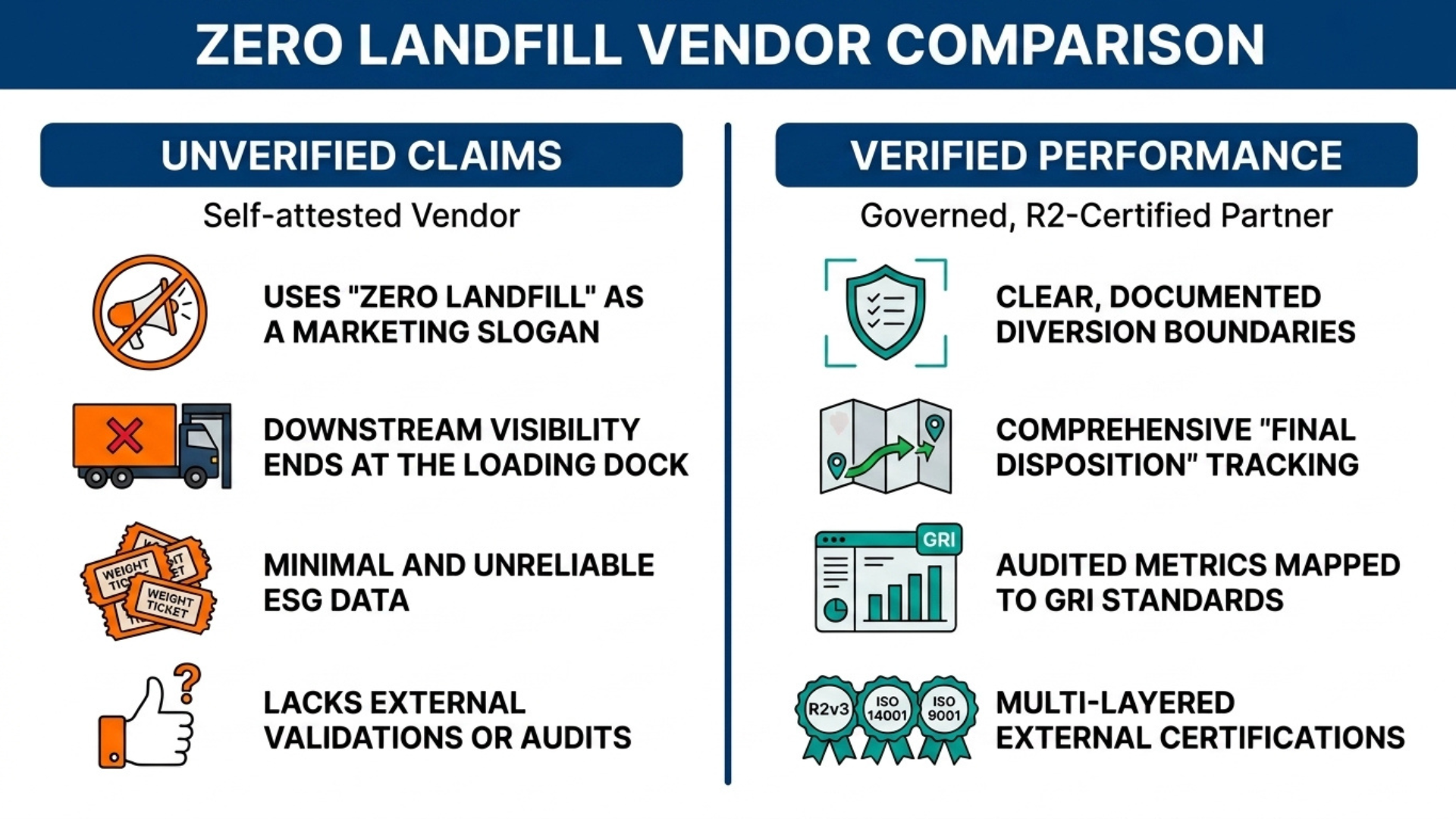
| Factor | Self-attested vendor | Governed, R2-certified partner |
|---|---|---|
| “Zero landfill” basis | Slogan, boundary undefined | Diversion boundary defined; validation frameworks like UL 2799 exist |
| Diversion definition | Often landfill-only | Can address landfill, incineration/WTE, and environment, per TRUE |
| Downstream visibility | Ends at the dock | Tracked to final disposition per R2v3 |
| Regulated materials | Variable | Refrigerant, PCB, battery, and oil controls built in |
| ESG documentation | Weight tickets, maybe | Weights by stream mapped to GRI 306 |
| Certifications | Claimed | R2, ISO 14001, and ISO 9001 on our Certifications page |
Start Your Teardown With a Partner Who Can Prove It
You have infrastructure to clear and an environmental commitment to keep. Quantum Technology delivers nationwide data center decommissioning services that prioritize reuse first, responsible recycling second, and documented disposition to support your ESG reporting. That is what a responsible data center teardown looks like when R2-certified decommissioning is done right.
Frequently asked questions
1. How do I make sure my data center equipment is recycled responsibly and not sent to landfill?
Choose a partner whose recycling is governed by final disposition. R2 covers the primary facility and its downstream vendors, so material is responsibly reused or recycled at every step, per SERI. Request downstream vendor lists and flow records, and verify the claim against the SERI facility directory.
2. What environmental and recycling certifications should a decommissioning vendor hold?
Look for R2, which the R2v3 summary shows enforces Focus Materials handling and downstream tracking, as well as environmental and quality management systems.
3. How do I confirm a vendor’s recycling meets R2 or e-Stewards standards for data center e-waste recycling?
Verify the certification directly rather than taking the vendor’s word for it. SERI maintains a directory of R2-certified facilities you can search, and you should request the downstream vendor verification and tracking records that R2v3 requires
.
4. Can you help track recycling rates for a Zero Landfill ESG report on our teardown?
Yes. We report weights by material stream and disposition method to support the total-weight, diverted-versus-disposed structure required by GRI 306: Waste 2020, and we pair electronics streams with documentation.
5. Why is R2 certification important when choosing a partner for responsible data center disposal?
R2 evaluates and monitors a business against a published standard, according to SERI, that is designed to protect the environment, worker health and safety, and communities. For infrastructure teardowns, it governs the exact hazardous streams that matter most: circuit boards, batteries, mercury, CRT glass, and PCBs.
Works Cited
- Cisco. (n.d.). What Is a Data Center? https://www.cisco.com/c/en/us/solutions/data-center-virtualization/what-is-a-data-center.html
- Electronic Code of Federal Regulations (eCFR). (2026a). Title 40 CFR Part 273 — Standards for Universal Waste Management. https://www.ecfr.gov/current/title-40/chapter-I/subchapter-I/part-273
- Electronic Code of Federal Regulations (eCFR). (2026b). Title 40 CFR Part 279 — Standards for the Management of Used Oil. https://www.ecfr.gov/current/title-40/chapter-I/subchapter-I/part-279
- Electronic Code of Federal Regulations (eCFR). (2026c). Title 40 CFR Part 761 — Polychlorinated Biphenyls (PCBs) Manufacturing, Processing, Distribution in Commerce, and Use Prohibitions. https://www.ecfr.gov/current/title-40/chapter-I/subchapter-R/part-761
- GBCI. (n.d.). About TRUE. https://www.gbci.org/about-true
- Global Reporting Initiative (GRI). (2020a). GRI 306: Waste 2020. https://www.globalreporting.org/publications/documents/english/gri-306-waste-2020/
- Global Reporting Initiative (GRI). (2020b). GRI 306 Standard PDF. https://globalreporting.org/pdf.ashx?id=12521
- Idaho National Laboratory (INL). (2026). Idaho National Laboratory Data Center Playbook. https://www.inl.gov/research/data-center-optimization-initiative/
- International Telecommunication Union (ITU). (2024a). Global E-Waste Monitor 2024. https://www.itu.int/en/ITU-D/Environment/Pages/Publications/The-Global-E-waste-Monitor-2024.aspx
- International Telecommunication Union (ITU). (2024b). The World Generated 62 Million Tonnes of Electronic Waste in Just One Year and Recycled Way Too Little, UN Agencies Warn. https://www.itu.int/hub/2024/04/the-world-generated-62-million-tonnes-of-electronic-waste-in-just-one-year-and-recycled-way-too-little-un-agencies-warn/
- Lawrence Berkeley National Laboratory / U.S. Department of Energy (LBNL/DOE). (2025). United States Data Center Energy Usage Report: 2025 Update. https://eta.lbl.gov/publications/united-states-data-center-energy-2025
- Legrand. (2025). The Complete Guide to Data Centre Infrastructure. https://www.legrand.com/datacenter/nl-en/news/the-complete-guide-to-data-centre-infrastructure
- Sustainable Electronics Recycling International (SERI). (n.d.-a). Frequently Asked Questions. https://sustainableelectronics.org/faq/
- Sustainable Electronics Recycling International (SERI). (n.d.-b). R2 Certification. https://sustainableelectronics.org/r2/
- Sustainable Electronics Recycling International (SERI). (n.d.-c). R2 Certified Facilities Directory. https://sustainableelectronics.org/find-an-r2-certified-facility/
- Sustainable Electronics Recycling International (SERI). (n.d.-d). Summary of R2v3 Requirements. https://sustainableelectronics.org/r2v3-summary/
- UL Standards & Engagement. (n.d.). UL 2799 Landfill Waste Diversion Claim Validations. https://www.ul.com/services/ul-2799-landfill-waste-diversion-claim-validations
- U.S. Environmental Protection Agency (EPA). (2026a). Learn About Pollution Prevention. https://www.epa.gov/p2/learn-about-pollution-prevention
- U.S. Environmental Protection Agency (EPA). (2026b). Lithium-Ion Battery Recycling Frequently Asked Questions. https://www.epa.gov/hw/lithium-ion-battery-recycling-frequently-asked-questions
- U.S. Environmental Protection Agency (EPA). (2026c). Disposal and Storage of Polychlorinated Biphenyl (PCB) Waste. https://www.epa.gov/pcbs/disposal-and-storage-polychlorinated-biphenyl-pcb-waste
- U.S. Environmental Protection Agency (EPA). (n.d.). Intentional Venting of Refrigerants (Section 608 of the Clean Air Act). https://www.epa.gov/section608
- U.S. Environmental Protection Agency (EPA). (2025a). Battery Collection Action: Case Study Lead-Acid Battery Collection. https://www.epa.gov/electronics-batteries-management/battery-collection-action-case-study-lead-acid-battery-collection
- U.S. Environmental Protection Agency (EPA). (2025b). Sustainable Materials Management: Non-Hazardous Materials and Waste Management Hierarchy. https://www.epa.gov/smm/sustainable-materials-management-non-hazardous-materials-and-waste-management-hierarchy
- U.S. Green Building Council (USGBC). (2025). TRUE Certification. https://support.usgbc.org/hc/en-us/articles/4431403163667-TRUE-certification
- World Health Organization (WHO). (2023). Electronic Waste (E-Waste). https://www.who.int/news-room/fact-sheets/detail/electronic-waste-%28e-waste%29