

Who Buys Used Industrial Generators (and What You Get Paid)
If you are closing a data center, clearing a building, or sitting on a backup power system you no longer need, one question comes first: who buys used industrial generators, and what will they actually pay you? This guide breaks down the secondary market for used diesel generators by brand, size, and condition so you know what to expect before you make a single call, and it shows how bundling generator removal into a full decommissioning project can raise your net payout.
TL;DR: The Fast Version
- Buyers fall into four groups: asset-recovery firms that bundle removal, specialty resellers, auction marketplaces, and export channels.
- Auction “Winning Offers” ran wide from 2024 to 2026: a 500 kW Cat 3412 that could not be started sold for $24,000 at a major commercial auction (about $48 per kW), while a serviced, load-tested 2000 kW unit was listed at $624,900 through a specialty reseller (about $312 per kW).
- Condition and proof of performance move the number: A 2000 kW Cat 3516B low-hour unit was listed at $325,500 in recent dealer inventory, roughly $163 per kW.
- Removal responsibility changes what you keep: On standard auction platforms, the buyer pays transport costs, and auction rigging is the buyer’s responsibility under standard auction terms. A bundled buyout can allow equipment revenue to offset your decommissioning costs, as it did in the AES / Blue Cross project.
- Emissions rules decide where a unit can go: Some gensets are labeled “FOR EXPORT SALE ONLY” and “Not Emissions Compliant” because of stationary-engine air requirements (EPA, 2021).
Who Buys Caterpillar and Cummins Diesel Generators Removed From a Data Center?
Caterpillar and Cummins diesel generators pulled from a data center are bought by four main types of buyers. Each type pays differently and handles removal differently, so the right buyer depends on how much of the physical work you want to keep versus hand off:
- Direct asset-recovery firms: These buyers purchase the generator and manage the physical removal as part of the same deal. Working directly with a comprehensive firm like Quantum Technology ensures you get a single consolidated offer and a single point of contact for the entire process.
- Specialty generator resellers: Similar to asset-recovery firms, these buyers offer written cash offers and will arrange disconnecting, rigging, and hauling before the pickup process starts.
- Auction marketplaces: Selling on major commercial and government auction sites provides price transparency, as completed sales publish a winning offer. Just remember that transparency cuts both ways: the buyer, not you, pays for transport under typical auction terms, and that reality is usually priced into their bids.
- Export-focused dealers: These buyers specialize in purchasing units that may not meet strict domestic stationary-engine emissions requirements and instead route them to international markets.
What Is My Decommissioned Data Center Generator Worth If I Sell It for Cash?
A decommissioned data center generator’s value depends on brand, size (kW), hours, emissions status, and whether it comes with proof that it runs. There is no single sticker price, but recently sourced sales provide reliable reference points for the resale value of used generators.
Here is what the market actually paid or asked in the last two years across various commercial and government surplus platforms:
- 500 kW Cat 3412 (skid-mounted, non-starting, missing batteries): Sold on 3/19/25 for $24,000 (approx. $48 per kW)
- 450 kW Marathon Electric: Sold on 3/19/25 for $21,000 (approx. $47 per kW)
- 200 kW Olympian D200P3: Sold on 2/26/25 for $20,000 (approx. $100 per kW)
- 50 kW Generac: Sold on 10/24/25 for $7,000 (approx. $140 per kW)
- 35 kW DHS: Sold on 6/28/24 for $2,600 (approx. $74 per kW)
- 30 kW Kohler (Unused): Sold on 1/31/26 for $10,000 (approx. $333 per kW)
Keep in mind that when buying or selling through these public auction channels, the buyer is typically responsible for rigging and transport costs.
Now compare those as-is auction numbers to serviced dealer listings. Here is what specialty dealers have recently asked for or received for retail-ready units:
- 2000 kW Cat 3516B (low-hour): Listed at $325,500 (approx. $163 per kW, with some units marked as sold)
- 2000 kW Multiquip (serviced, load-tested): Sold for $624,900 (approx. $312 per kW)
- 800 kW Caterpillar 3508TA: Listed between $73,500 and $85,500 (approx. $92 to $107 per kW)
- 750 kW Unit: Listed at $83,500 (approx. $111 per kW)
How Is the Resale Value of a Used Backup Generator (Caterpillar, Cummins, Kohler) Determined?
Recent sales on a per-kW basis can provide a rough market reference, but actual offers depend heavily on model, age, hours, condition, emissions status, configuration, location, and removal requirements. Rather than a strict formula, think of per-kW pricing as a useful comparison metric that is then heavily adjusted based on logistics and equipment health.
1. Look at market comparables.
The sourced sales above show a wide range, from roughly $47 per kW for a non-starting large diesel set to over $333 per kW, depending on the generator, size, and condition. This enormous range shows why $/kW isn’t a strict valuation model, but rather a starting point to see where similar units have recently landed before condition and logistics are factored in.
2. Factor in the variables buyers actually price.
- Hours and records: EPA compliance rules require emergency engines to have an hour meter and recorded hours of operation (EPA, 2021). Low, documented hours support a higher number.
- Proof that it works: Verification through load bank testing ensures that a standby system is properly loaded and helps reduce wet-stacking, a practice strongly recommended alongside periodic maintenance (Cummins, 2022; NFPA, 2022). Sellers market this heavily: premium dealer listings call out being serviced and load-tested, highlighting load-bank testing, a UL-listed base tank, and very low hours.
- Emissions status: Mandatory emissions compliance can restrict where a unit can be legally installed or resold (CARB, 2021).
- Logistics: If a seller is paying to rig and haul, that cost is deducted from the gross to arrive at the net.
For any make, whether Caterpillar, Cummins, Kohler, or otherwise, sellers should collect the same intake specs that a buyer will ask for: brand, model, serial number, year, kW/kVA, voltage, phase, frequency, hours, and condition. Our generator valuation intake captures exactly these fields, and having them ready is the fastest route to an accurate estimate.
Why Do Emissions Rules Decide Where a Generator Can Be Sold?
Emissions rules decide where a generator can be sold because stationary-engine air requirements limit which units can be legally installed for stationary use in stricter jurisdictions (EPA, 2021). That is why some sellers route certain gensets to export channels rather than to domestic buyers.
Stationary-engine requirements vary based on engine characteristics, age (new vs. existing), location (area vs. major source), and ignition type (compression vs. spark) (EPA, 2021). To determine if a generator can be legally installed, buyers and sellers must navigate several layers of regulation:
- Federal Standards: The New Source Performance Standards (NSPS) for stationary diesel engines are set forth in 40 CFR Part 60, Subpart IIII (EPA, 2021).
- California State Rules: California’s Airborne Toxic Control Measure (ATCM) applies to anyone who sells, offers for sale, leases, or purchases a stationary compression-ignition engine for use in California, subject to specific exceptions (CARB, 2021).
- Local Air District Mandates: Local jurisdictions enforce state rules, such as the South Coast AQMD’s Rule 1470, which implements CARB’s ATCM to strictly control particulate matter emissions (SCAQMD, 2021).
The practical effect shows up in dealer inventory. Dealer inventory documents repeatedly label certain sets “FOR EXPORT SALE ONLY” and “Not Emissions Compliant”. A unit that cannot be deployed domestically in a strict market has a smaller buyer pool, and that affects both price and destination. Because compliance is situation-dependent, any claim that a unit is compliant and installable in a given location should be verified by an air-permitting professional before it is marketed as such.
Do Decommissioning Companies Pay More for Generators If They Also Handle Removal?
Decommissioning companies that handle removal can put more money in a seller’s pocket because equipment revenue can offset decommissioning costs rather than being eaten by third-party rigging and freight bills. When one company buys the asset and handles the removal, sellers compare a single net check rather than a gross price minus a stack of separate invoices.
Contrast that with auction and third-party channels, where removal lands on someone else’s tab. Standard auction listing terms state that the buyer is responsible for all transport costs, and typical auction terms specify that rigging is the buyer’s total responsibility. When the buyer carries those costs, they price the difficulty of the loadout into their bid. So the headline number and the seller’s net check are not the same thing.
Comparison Table: How the Selling Channels Stack Up
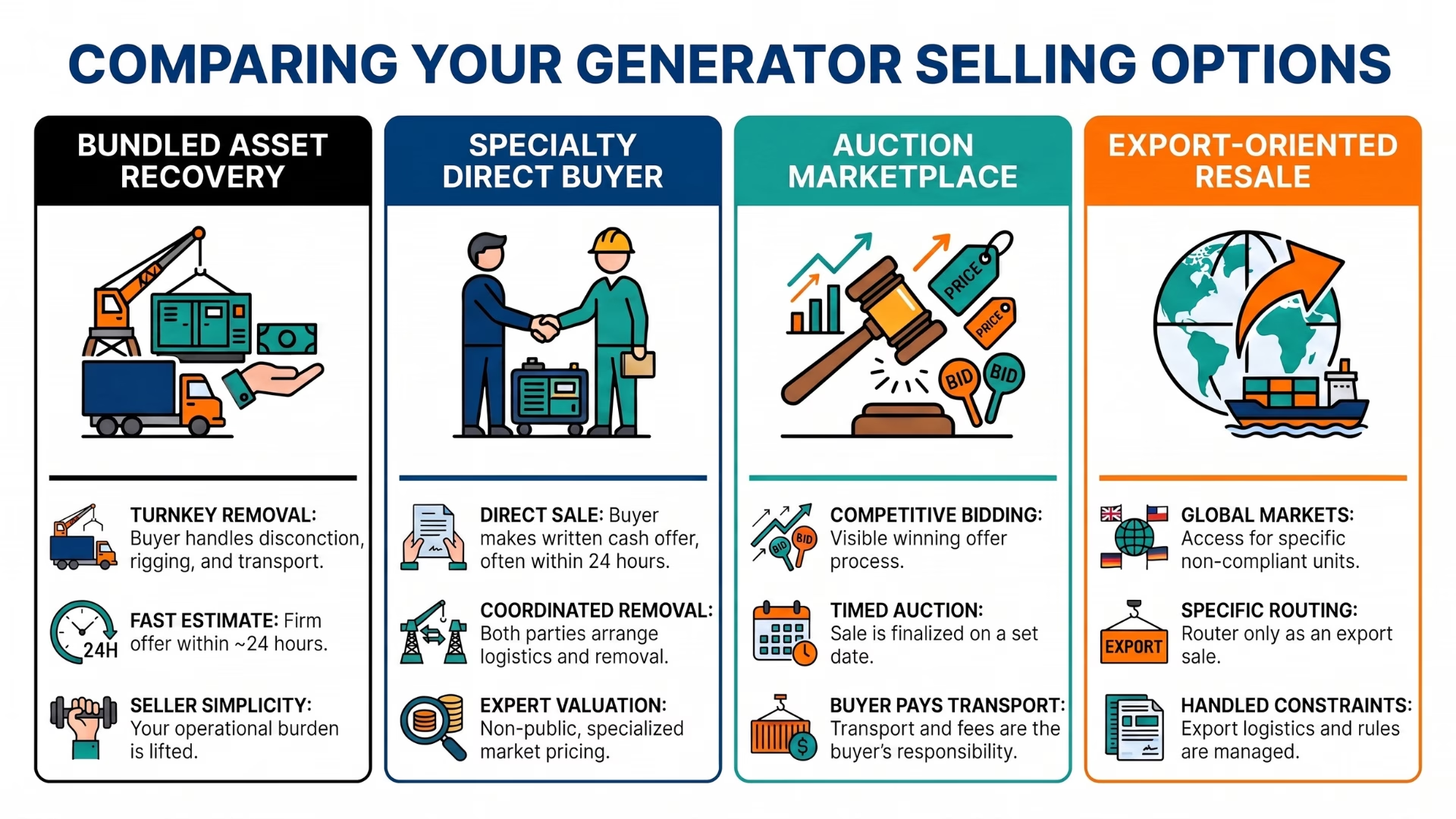
| Channel | What it is | Payout signal | Speed signal | Who handles removal |
|---|---|---|---|---|
| Direct sale to an asset-recovery buyer (bundled with removal) | Buyer purchases the genset and bundles disconnect, rigging, and freight | The valuation model uses actual sales data; equipment revenue can offset decommissioning costs, as described on our used generators page | Firm estimate in 24 hours / one business day | Seller’s burden lifted; disconnection, rigging, transport handled |
| Direct sale to a specialty generator buyer | Buyer purchases the generator, often nationwide | Case-by-case, not priced publicly | Written cash offer within 24 hours; quick quote | Both describe arranging removal and transport |
| Auction marketplace | Competitive bidding with a visible winning offer | Public realized prices by date | The sale closes when the auction ends | Buyer pays transport; fees published in listing terms |
| Export-oriented resale | Non-compliant or mismatched units routed out of strict jurisdictions | Positioned as export sale only | Not applicable | Export constraints apply |
A Step-by-Step Checklist to Get the Best Price
Follow these steps in order. Each one either protects the net payout or removes a reason for a buyer to discount the unit.
- Inventory and document the asset before removal: Inventory is the first step in data center decommissioning. Capture nameplate data and site context with easy access.
- Record the core specs: Pull brand, model, serial, year, kW/kVA, voltage, phase, frequency, and condition, using the same fields as in our generator valuation intake.
- Confirm stationary-engine compliance for the destination jurisdiction: Check the EPA overview of stationary engine rules, the Subpart IIII standards, and, if California is in play, the ATCM applicability text and SCAQMD Rule 1470 before calling the unit deployable anywhere (EPA, 2021; CARB, 2021).
- Collect hour-meter evidence and operating-hour logs: EPA compliance rules require emergency engines to have an hour meter and to record operating hours (EPA, 2021). Buyers and regulators both want to see them.
- If maximizing value, run and document a load bank test: Keep the report with the sales package. Manufacturer testing protocols and NFPA standards detail full-load testing guidelines (Cummins, 2022; NFPA, 2022).
- Plan a safe disconnection using lockout/tagout procedures: Follow the OSHA lockout/tagout standard (OSHA, 2020), especially when the genset is part of a larger decommissioning project.
- Handle fluids responsibly: The EPA’s waste management hierarchy favors reuse and recycling over disposal, and used-oil standards are in 40 CFR Part 279 (EPA, 2020). Our team drained and recycled diesel fuel as part of the AES/Blue Cross project.
- If going the auction route, model net proceeds: Factor in the published fee tiers, buyer-transport responsibility, and the fact that rigging falls on the buyer, which usually discounts hard loadouts.
- If a single consolidated offer is preferred, request one net number: ask for a single figure that covers equipment purchase and turnkey removal, so it is clear whether equipment revenue offsets the decommissioning cost, as it did in the AES/Blue Cross case study.
Why Sell to a Buyer Who Also Does the Removal?
If you type ‘company that buys generators near me for cash’ into a search engine, you’ll find endless options, but choosing a direct asset-recovery partner streamlines logistics significantly. We buy used gensets ranging from 35 kW to 3.5+ MW and provide a firm cash estimate within 24 hours. The removal side, including disconnection, rigging, and transport, is handled by certified technicians with full insurance coverage. Diesel fuel is drained and recycled, which aligns with the EPA’s preference for reuse and recycling over disposal (EPA, 2020). For facility owners and property teams clearing a building, that is the difference between managing five contractors and making one call.
Frequently Asked Questions
1. Who buys Caterpillar and Cummins diesel generators removed from a data center?
Caterpillar and Cummins gensets are bought by asset-recovery firms, specialty resellers, auction marketplaces, and export dealers. While various specialty resellers purchase gensets and arrange removal, utilizing a full-service asset-recovery firm like Quantum Technology streamlines the process and maximizes your payout.
2. What is a decommissioned data center generator worth if it is sold for cash?
Its value is driven by size, hours, emissions status, and proof it runs. Recent auction sales ranged from about $47 per kW for a non-starting 500 kW Cat 3412 to about $312 per kW for a serviced, load-tested 2000 kW unit. The best way to pin down a figure is to gather the specs and request a firm estimate.
3. How is the used generator resale value of a Caterpillar, Cummins, or Kohler unit determined?
While recent sales on a per-kW basis can provide a rough market reference, there is no strict mathematical formula. Actual offers depend heavily on the specific model, age, hours, condition, emissions status, configuration, location, and removal requirements. A documented load bank test and low recorded operating hours push the number up; unknown conditions and hard loadouts push it down.
4. Do decommissioning companies pay more when sellers buy used diesel generators and bundle the removal into a single deal?
They can improve the net payout because equipment revenue offsets the decommissioning cost, rather than being reduced by separate rigging and freight bills. Quantum Technology used equipment revenue to offset decommissioning costs in the AES/Blue Cross project, while auction channels put transport and rigging on the buyer, who prices them into their offer.
Works Cited
- California Air Resources Board (CARB). (2021). Airborne Toxic Control Measure for Stationary Compression Ignition Engines.
https://ww2.arb.ca.gov/our-work/programs/stationary-diesel-atcm - Cummins. (2022). Load Bank Performance Testing Guidance.
https://www.cummins.com/en-na/na/sales-and-service/load-bank-performance-testing - National Fire Protection Association (NFPA). (2022). NFPA 110: Standard for Emergency and Standby Power Systems.
https://www.nfpa.org/codes-and-standards/nfpa-110-standard-development/110 - South Coast Air Quality Management District (South Coast AQMD). (2021). Rule 1470: Requirements for Stationary Diesel-Fueled Internal Combustion Engines. https://www.aqmd.gov/home/rules-compliance/compliance/rule-1470-requirements
- U.S. Environmental Protection Agency (EPA). (2021). Standards of Performance for Stationary Compression Ignition Internal Combustion Engines (40 CFR Part 60 Subpart IIII).
https://www.ecfr.gov/current/title-40/chapter-I/subchapter-C/part-60/subpart-IIII - U.S. Environmental Protection Agency (EPA). (2020). Standards for the Management of Used Oil (40 CFR Part 279).
https://www.epa.gov/hw/managing-used-oil-answers-frequent-questions-businesses - U.S. Occupational Safety and Health Administration (OSHA). (2020). Control of Hazardous Energy (Lockout/Tagout) (29 CFR 1910.147).
https://www.ecfr.gov/current/title-29/subtitle-B/chapter-XVII/part-1910/subpart-J/section-1910.147
